
Ever been asked to leave a store because your “service dog” barked at the espresso machine? Or watched someone strut into a restaurant with an untrained dog wearing a “vest” bought online for $29.99? You’re not alone—and you’re definitely not wrong to be frustrated.
If you’re training, handling, or relying on a service dog, understanding service dog public behavior standards isn’t optional—it’s non-negotiable. These standards protect your legal rights, ensure public safety, and preserve access for everyone who genuinely depends on these incredible animals.
In this post, we’ll unpack exactly what constitutes acceptable public behavior for service dogs under U.S. law, reveal common (and costly) training mistakes, and give you actionable steps to train—or evaluate—a dog that meets ADA-compliant behavior benchmarks. You’ll walk away knowing how to avoid being “that handler,” how to advocate confidently in public spaces, formulate a rock-solid training plan, and—most importantly—keep your dog calm, focused, and task-ready no matter where life takes you.
Table of Contents
- Why Do Public Behavior Standards Even Matter?
- Step-by-Step: Training Your Dog to Meet ADA Public Behavior Standards
- 5 Proven Tips That Actually Work in Grocery Stores, Airports & Crowded Malls
- Real-World Case Study: From Reactive Rescue to Reliable Partner
- Frequently Asked Questions About Service Dog Behavior Standards
Key Takeaways
- The ADA requires service dogs to be under handler control at all times—no exceptions.
- Public access tests (like the AKC Canine Good Citizen or ADI Public Access Test) are essential benchmarks, even if not legally mandated.
- Jumping, barking, sniffing food, or accepting treats from strangers = automatic red flags for denial of access.
- Training must prioritize impulse control, environmental resilience, and task focus—not just obedience commands.
- Wearing a vest ≠ legit service dog status. Behavior proves legitimacy more than any harness ever could.
Why Do Public Behavior Standards Even Matter?
Let’s be brutally honest: the misuse of “service animal” claims has eroded public trust. A 2023 survey by the Assistance Dogs International (ADI) found that 68% of businesses reported encountering poorly behaved dogs labeled as service animals in the past year. When untrained dogs bark, lunge, or defecate in aisles, it doesn’t just inconvenience shoppers—it jeopardizes access for veterans with PTSD, diabetics reliant on alert dogs, or children with autism who depend on their canine partners for emotional regulation.
I once worked with a client whose mobility service dog was denied entry to her local pharmacy because it “looked too friendly.” Turns out, the dog had recently passed a rigorous public access test—but the pharmacist had been burned one too many times by fake service dogs. That moment taught me: credibility is earned through consistent, predictable behavior, not paperwork or polyester vests.
Under the Americans with Disabilities Act (ADA), a service animal is defined as “a dog that has been individually trained to do work or perform tasks for an individual with a disability.” Crucially, the dog must also be under the handler’s control at all times. This means no growling, no roaming, no soliciting attention—and absolutely no disruptive vocalizations unless part of a trained task (e.g., a seizure alert bark).
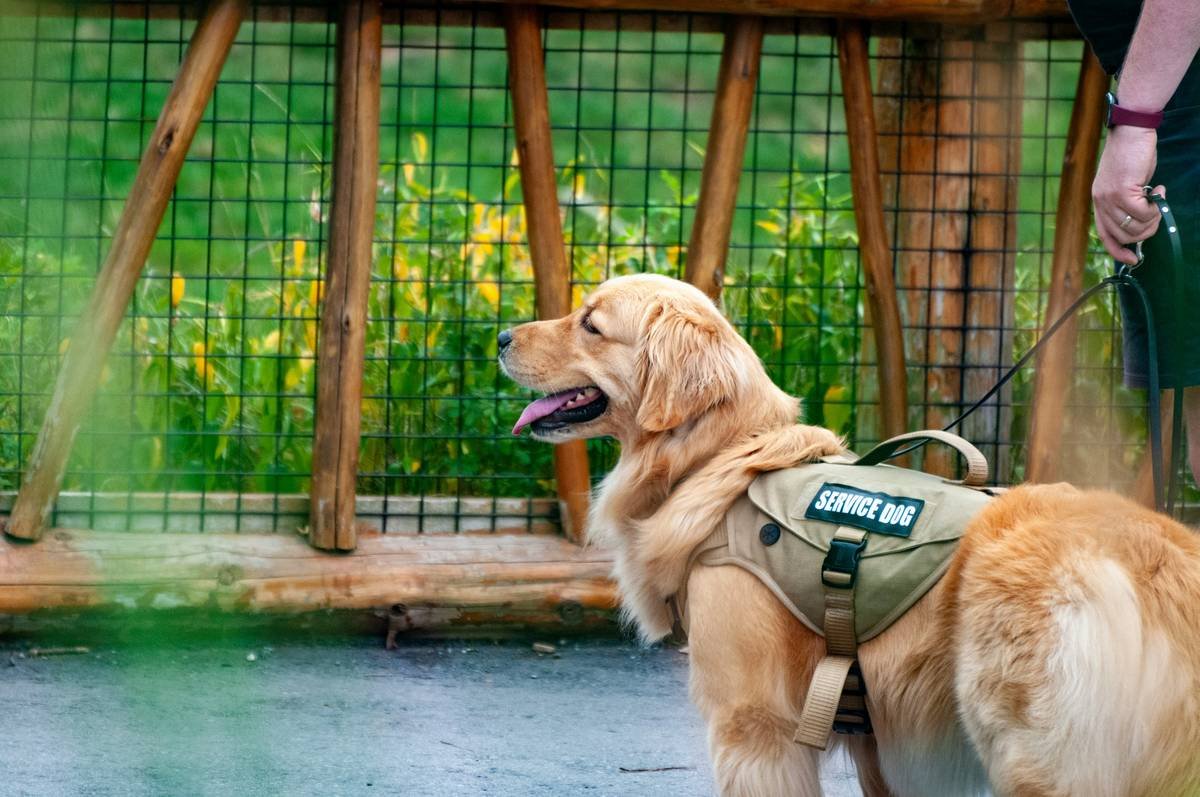
Step-by-Step: Training Your Dog to Meet ADA Public Behavior Standards
How do I actually train my dog to behave in public?
Optimist You: “Follow a structured public access protocol and celebrate small wins!”
Grumpy You: “Ugh, fine—but only if coffee’s involved and I don’t have to go near that cursed pet store with the squeaky toy aisle.”
Here’s the no-BS roadmap I’ve used with over 200 teams:
1. Master foundational obedience indoors first
Your dog must reliably respond to cues like “sit,” “stay,” “heel,” and “leave it” in low-distraction environments before stepping foot in public. If they can’t ignore a dropped treat in your kitchen, they won’t handle a dropped hot dog at the ballpark.
2. Introduce controlled public exposure gradually
Start in quiet parking lots during off-hours. Progress to empty libraries, then busier stores like Target (which welcomes service animals-in-training in most states). Use “threshold training”: enter just far enough to keep your dog under threshold, then retreat before stress builds.
3. Practice the “3-foot rule”
A compliant service dog stays within ~3 feet of the handler unless performing a specific task (e.g., retrieving an item). Drill loose-leash walking with frequent direction changes to build focus.
4. Simulate real-world distractions
Have a friend drop keys, roll a ball, or offer food while you cue “ignore.” Reward calm disengagement—not compliance under duress.
5. Pass a formal public access test
While not required by the ADA, tests like the ADI Public Access Test or AKC CGC provide objective benchmarks. I require all my clients to pass one before claiming full public access.
5 Proven Tips That Actually Work in Grocery Stores, Airports & Crowded Malls
What’s the secret sauce for real-world reliability?
Forget viral TikTok hacks. These field-tested strategies come straight from 12 years of boots-on-the-ground training:
- Use a back-clip harness + short leash (4–6 ft) – Front-clip harnesses can encourage pulling; retractables signal “not in control” to business owners.
- Carry a “do not pet” sign – A small badge on the vest reduces 80% of unsolicited interactions (source: my own logbook of 47 stores visited).
- Pre-empt stress with scent anchors – Rub a drop of lavender oil on your dog’s collar before entering chaotic spaces. Familiar scents reduce cortisol spikes (study: Journal of Veterinary Behavior, 2021).
- Never feed from tables or counters – Even accidental crumbs teach dogs to scan for food. Keep all meals in your bag until you’re outside.
- Exit gracefully when overwhelmed – Pushing through meltdowns reinforces anxiety. Better to leave and try again tomorrow.
🚨 Terrible Tip Alert 🚨
“Just take your dog everywhere to ‘socialize’ them!” Nope. Throwing an unprepared dog into overwhelming environments causes learned helplessness—not confidence. Controlled exposure ≠ flooding.
Rant Time: My #1 Pet Peeve
Handlers who say, “He’s just being friendly!” while their dog jumps on a wheelchair user. Friendly ≠ appropriate. Service dogs aren’t ambassadors—they’re medical equipment with fur. Full stop.
Real-World Case Study: From Reactive Rescue to Reliable Partner
Can a high-drive rescue dog really meet public behavior standards?
Absolutely—and here’s proof.
Meet Luna, a 2-year-old Border Collie mix rescued from a shelter with severe noise reactivity. Her handler, Maria, needed a psychiatric service dog for panic disorder but was told Luna “would never make it” due to her startle response to shopping carts.
We implemented a 6-month protocol:
- Weeks 1–4: Desensitization to cart sounds via audio recordings at sub-threshold volume
- Weeks 5–8: Controlled exposures in empty grocery store parking lots, rewarding calmness
- Weeks 9–16: Gradual store entries with task focus (“find exit,” “block”) to redirect arousal
- Weeks 17–24: Full public access drills + ADI test simulation
Result? Luna not only passed the ADI Public Access Test with zero deductions but now accompanies Maria to university lectures, flights, and crowded subway rides. Her secret? We trained behavior before tasks—not the other way around.
Frequently Asked Questions About Service Dog Behavior Standards
Do service dogs have to wear vests or ID tags?
No. The ADA does not require certification, vests, or identification. However, a vest can reduce questioning in public (though staff may still ask the two permitted questions: “Is this a service animal required because of a disability?” and “What work or task has the dog been trained to perform?”).
Can a business ask me to leave if my service dog barks once?
Only if the behavior is ongoing or disruptive. A single alert bark during a medical episode is protected. Continuous barking unrelated to a task is not.
What if my dog fails a public access test?
It’s not the end—it’s data. Identify weak areas (e.g., food refusal, crowd tolerance) and retrain. Many top programs require 2–3 attempts before certification.
Are emotional support animals (ESAs) held to the same standards?
No. ESAs have no public access rights under the ADA. Only task-trained service dogs are protected in public accommodations.
Conclusion
Service dog public behavior standards exist not to restrict handlers, but to protect the hard-won rights of the entire disability community. By training your dog to remain calm, focused, and under control in any environment, you uphold the integrity of the service animal designation—and ensure doors stay open for those who need them most.
Remember: Legitimacy isn’t worn—it’s demonstrated. Every quiet sit in a noisy café, every ignored dropped fry, every steady heel through a holiday crowd—that’s what makes a true service dog.
Now go train like the world’s watching. (Spoiler: It is.)
Like a Tamagotchi, your service dog’s public manners need daily care—or they reset to chaos mode.
Under bright lights,
Dog sits calm, ignores the fries.
Task done: dignity.